Asia Week New York 2026: Six Celestials: Tomimoto, Ishiguro, Kawai, Kamoda, Okabe, & Tanaka S
-

-
-
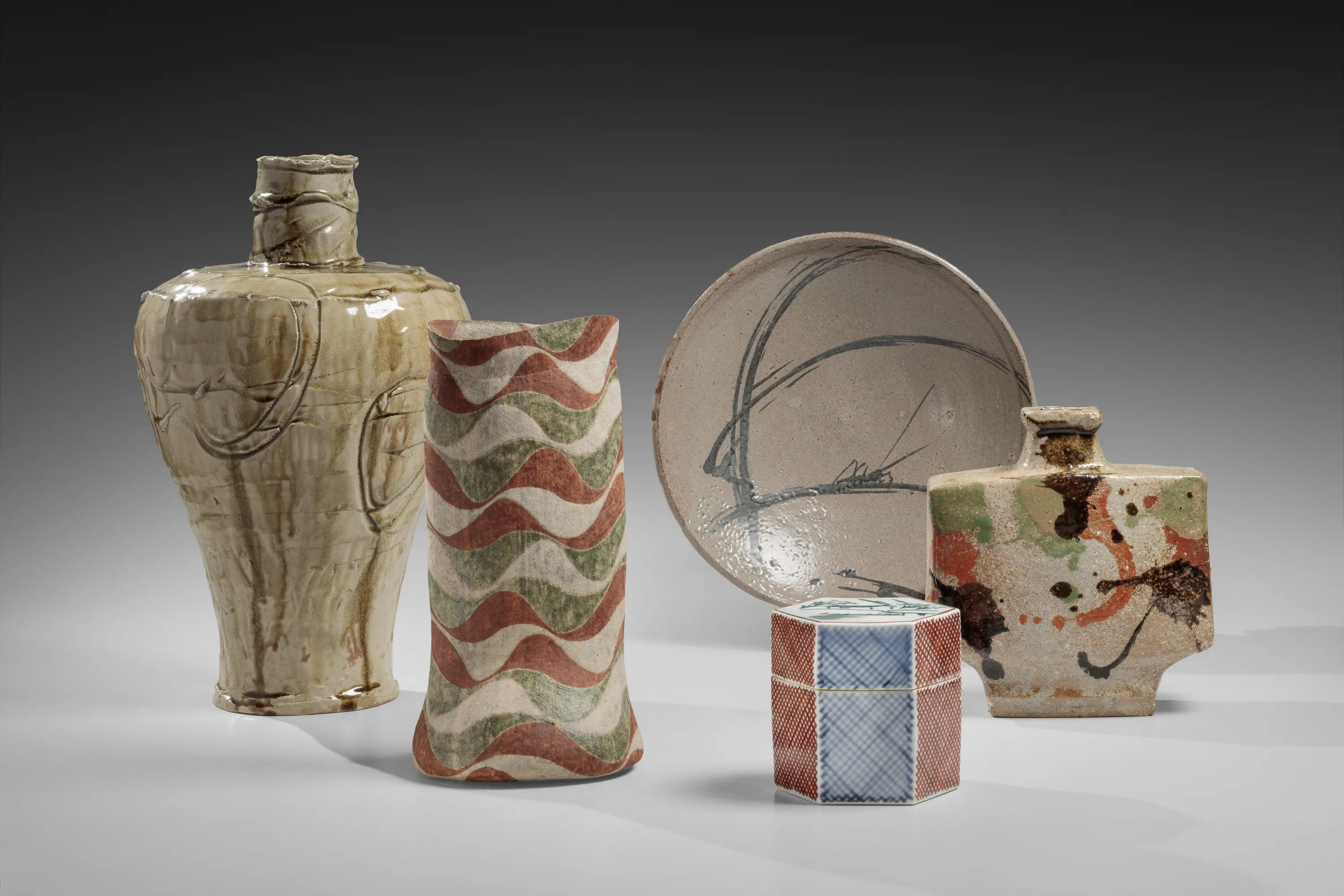
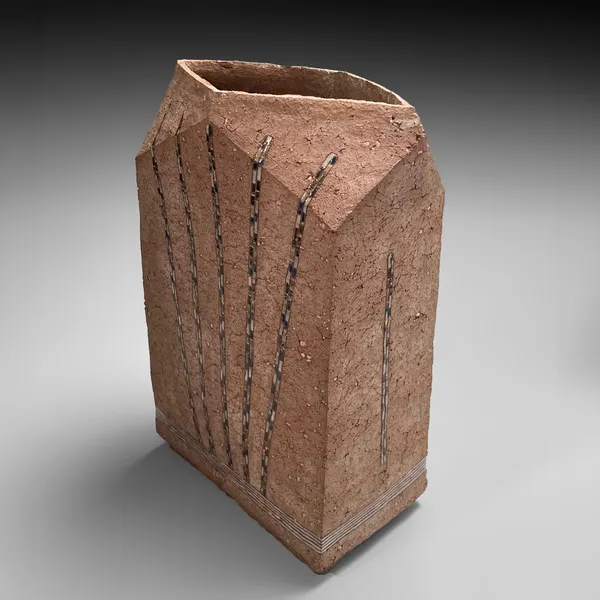
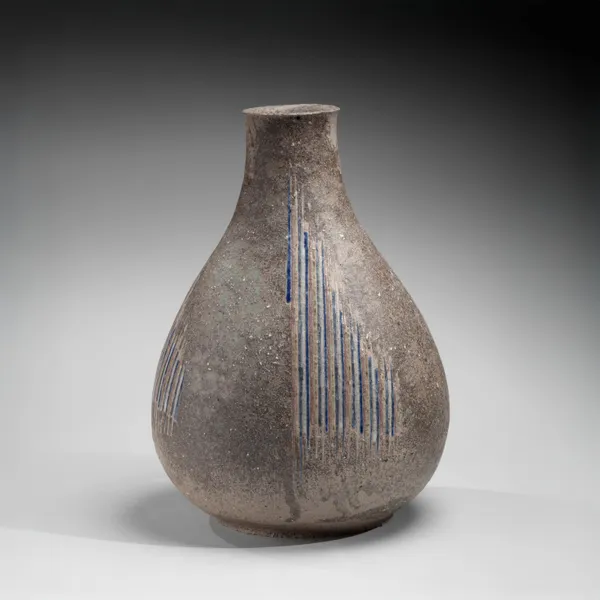
For Asia Week New York this coming March, Joan B Mirviss LTD, in collaboration with Shibuya Kurodatoen, Co., LTD, presents Six Celestials, an exhibition featuring masterpieces by six artists whose seminal careers established the foundations of contemporary Japanese clay art. By placing their diverse bodies of work in conversation, the exhibition highlights the ways in which each of these twentieth-century icons helped pave the way for the emergence of Japanese ceramics as it exists today—one of the most dynamic and exciting fields of contemporary art.
Born as the nineteenth century drew to a close, three of the artists in this exhibition played critical roles ushering Japanese clay into the twentieth century. As the founder of the ceramics department at Kyoto City University of Arts and longtime professor, Tomimoto Kenkichi (1886-1963) was a fierce advocate of individuality, a trait that is captured in his own elegantly formed and decorated porcelain vessels as well as in the diverse body of work that has been produced by his many students. The work of Ishiguro Munemaro (1893-1968) is bold and undeniably modern even as it was rooted in the ancient Chinese techniques that he dedicated his life to researching. In contrast with these contemporaries of his, both of whom were designated with the prestigious title of Living National Treasure for their work, Kawai Kanjirō (1890-1966) held true to the spirit of the Mingei (folk art) Movement he helped pioneer by eschewing official honors or recognition for his undisputed mastery of historical glazes.
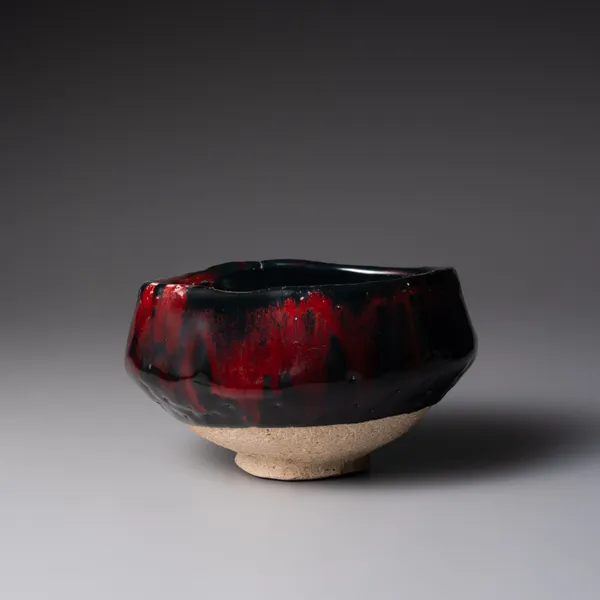
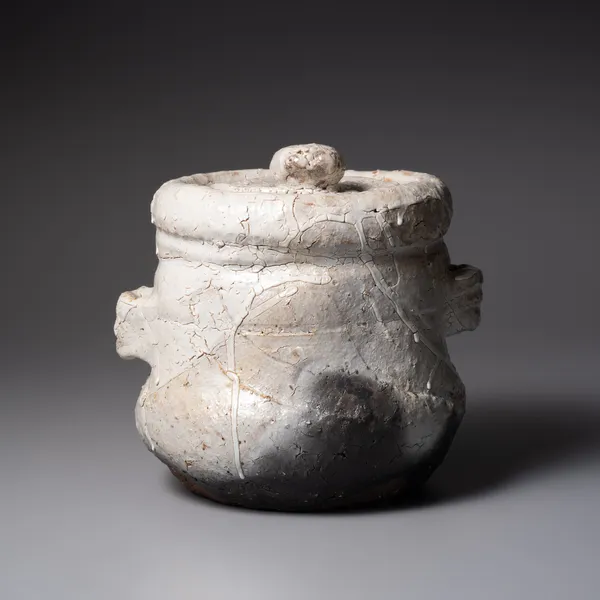
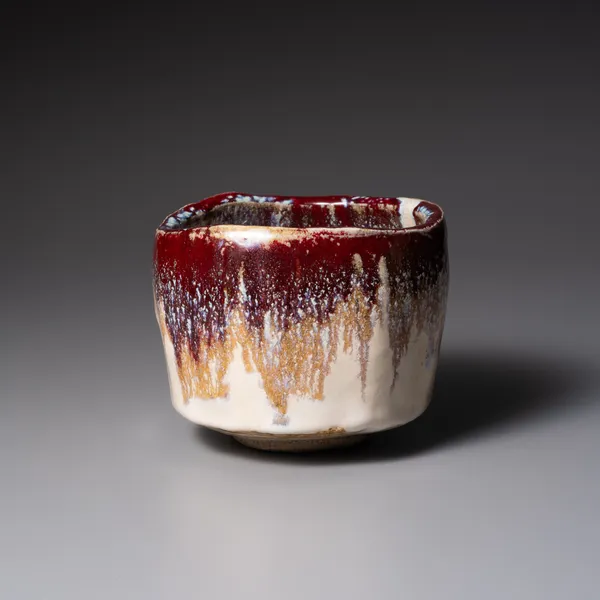
As representatives of the next generation, the remaining three artists of this exhibition developed their ceramic legacies in the second half of the twentieth century. Though he studied the historical glazes of Shino, Oribe, and celadon, Okabe Mineo (1919-1990) breathed new life into these traditions with his innovative and entirely unique forms. With his ever-evolving palette of glazes, patterns, and forms, Kamoda Shōji (1933-1983) created some of the most evocative and sought-after works of the twentieth century. Finally, Tanaka Sajirō (b. 1937) continues to hone his skills in the art of wood-firing with natural glazes to create vibrant and contemporary works inspired by the historical tradition of Karatsu wares.
This exhibition features more than forty masterpieces equally distributed between these six artists, many of which have been exhibited and published in Japan. Works by these luminaries can be found in the collections of prominent museums worldwide, including the Metropolitan Museum of Art, NY; Art Institute of Chicago, IL; National Museum of Asian Art, Washington, D.C.; National Museums of Modern Art, Kyoto and Tokyo; Museum of Fine Arts, Boston; Musée Tomo, Tokyo; Victoria & Albert Museum, London; and Minneapolis Institute of Art, MN.
Six Celestials opens on March 19 and runs through April.
The gallery is open to visitors weekdays, 11am to 6pm and by appointment.
Opening March 19, 2026, as part of Asia Week New York
Opening Party: March 19, 2026, 5pm–8pm
For Asia Week New York, we will also have special weekend hours:
Saturday, March 21 (11am to 6pm)
Sunday, March 22 (12pm to 5pm)
-
Artworks
-
TOMIMOTO KENKICHI
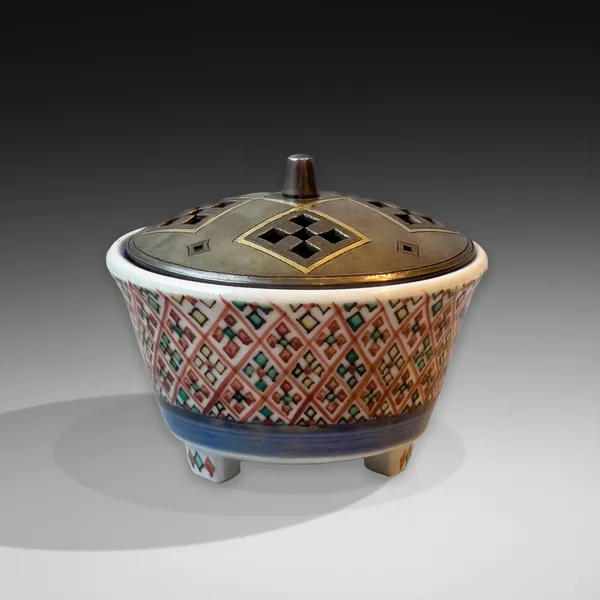
Iro-e (enamel overglaze) incense burner with geometric polychrome diamond-shaped designs and perforated metal lid, 1949Glazed porcelain; metal cover
3 1/8 x 3 3/4 in.
Potter’s mark: 富 (Tomi) painted on bottom
Box title: 色繪 香爐 (Iroe kōro); Polychrome Overglazed Incense Burner
Box signature: 富本憲吉造 (Tomimoto Kenkichi zou); Created by Tomimoto Kenkichi
Box seal: 富 (Tomi) -
TOMIMOTO KENKICHI
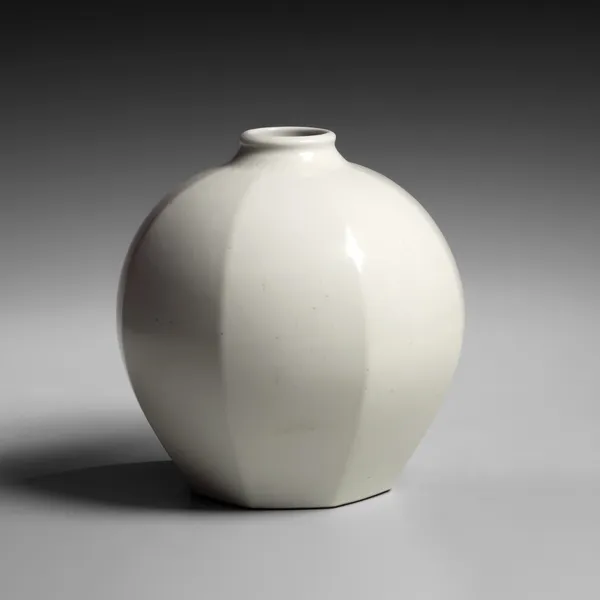
Faceted white porcelain vessel with narrow, upraised neck, 1932White glazed porcelain
8 3/8 x 8 3/8 in.
Potter’s mark: 富 (Tomi) painted on bottom
Box title: 白磁八角壷 (Hakuji hakkaku tsubo); White Porcelain Octagonal Vessel
Box signature:
千九百三拾弍年新春 (Senkyūhyakusanjūninen shinshun); 1932 Early Spring
富本憲吉造 (Tomimoto Kenkichi zou); Made by Tomimoto Kenkichi
Box seal: 富 (Tomi) -
TOMIMOTO KENKICHI
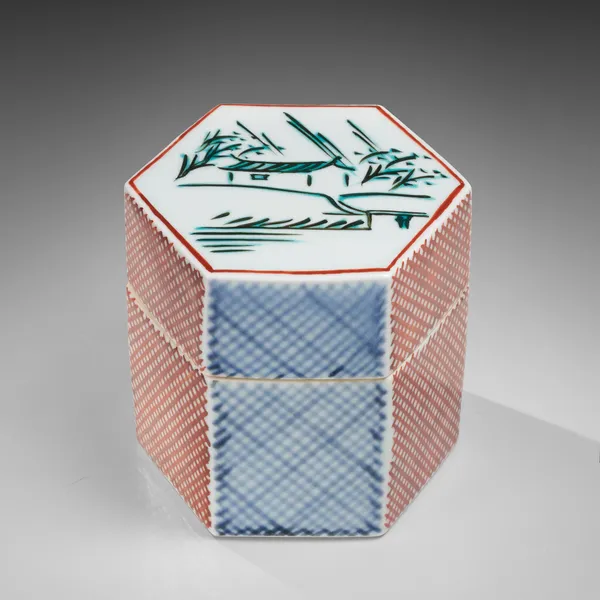
Iro-e (enamel overglaze) hexagonal covered box with landscape motif of “Rain on the Yamato River”, 1960Glazed stoneware, metal
4 3/4 x 4 3/4 x 4 1/4 in.
Potter’s mark: 富 (Tomi) painted on bottom
Box title: 色繪 大和川急雨 六角飾箱 (Iroe Yamatogawa kyūu rokkaku kazaribako);
Polychrome Overglazed Hexagonal Covered Box with Decoration of Rain Shower on the Yamato River
Note: 大和川(the Yamato River) is located in Ando village, Nara Prefecture where Tomimoto was born.
Box signature: 富本憲吉造 (Tomimoto Kenkichi zou); Created by Tomimoto Kenkichi
Box seal: 富 (Tomi) -
TOMIMOTO KENKICHI
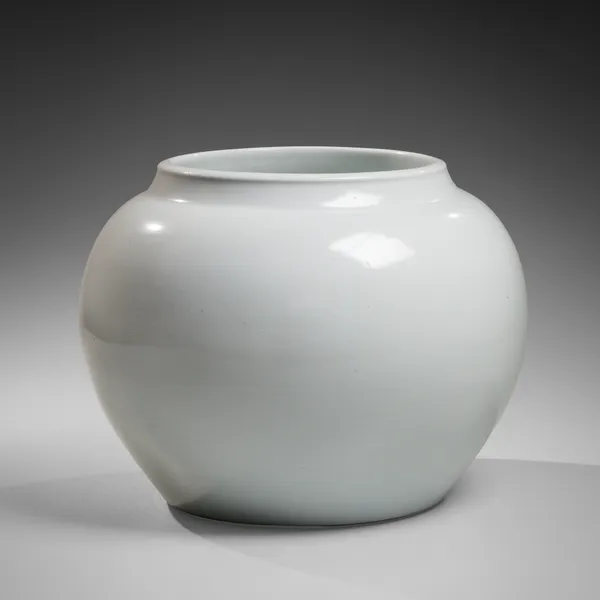
Large round white vessel with raised, wide mouth, 1940Glazed porcelain
10 1/8 x 13 1/4 in.
Potter’s mark: 富 (Tomi) painted on bottom
Box title:
紀元二千六百年 仲秋 (Kigen nisenroppyaku nen chūshū); August in 1940
Box signature: 富本憲吉造 (Tomimoto Kenkichi zou); Made by Tomimoto Kenkichi
Box seal: 富 (Tomi) -
TOMIMOTO KENKICHI
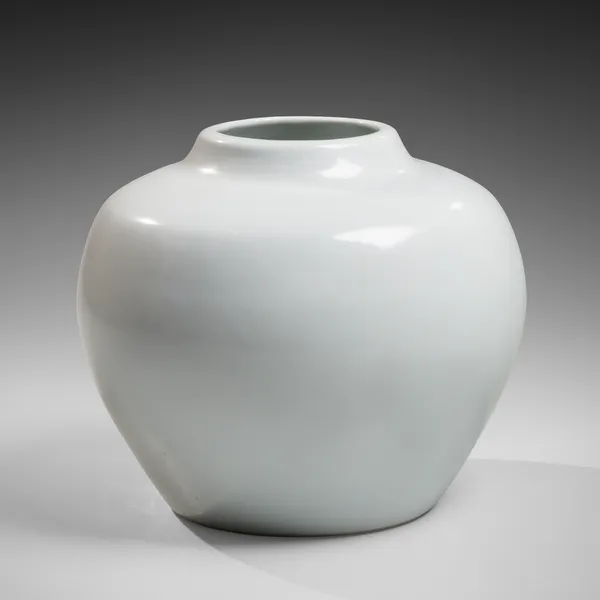
Rounded white vessel with slightly slanted shoulders and short, raised mouth, 1942Glazed porcelain
7 3/4 x 9 3/8 in.
Potter’s mark: 富 (Tomi) painted on bottom
Box title: 白磁壷 (Hakujiko); White Porcelain Vessel
Box signature: 富本憲吉造 (Tomimoto Kenkichi zou); Created by Tomimoto Kenkichi
Box seal: 富 (Tomi) -
TOMIMOTO KENKICHI
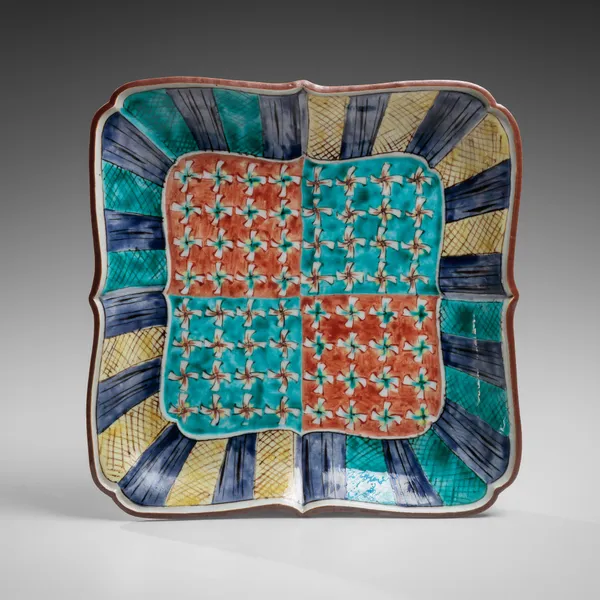
Iro-e (enamel overglaze) slightly recessed rounded square platter with foliated rim, sarasatic-patterned four-petaled floral patterning, 1936Glazed Kutani porcelain
2 x 11 1/4 x 11 1/4 in.
Potter’s mark: 富 (Tomi) painted on bottom
Box title: 色繪更紗風角鉢 (Iroe sarasafū kakubachi); Polychrome Enamel Overglazed Square Bowl with Sarasa-style Decoration
初めて九谷の素地を用ひ 東京に於いて試みたる 色絵家宝 (Hajimete Kutani no soji o mochii Tokyo ni oite kokoromitaru iroe kahō);
Polychrome enamel overglazed family treasure created as an initial experiment in Tokyo using Kutani porcelain
Box signature: 富本憲吉造 (Tomimoto Kenkichi zou); Created by Tomimoto Kenkichi
Box seal: 富 (Tomi) -
KAWAI KANJIRŌ
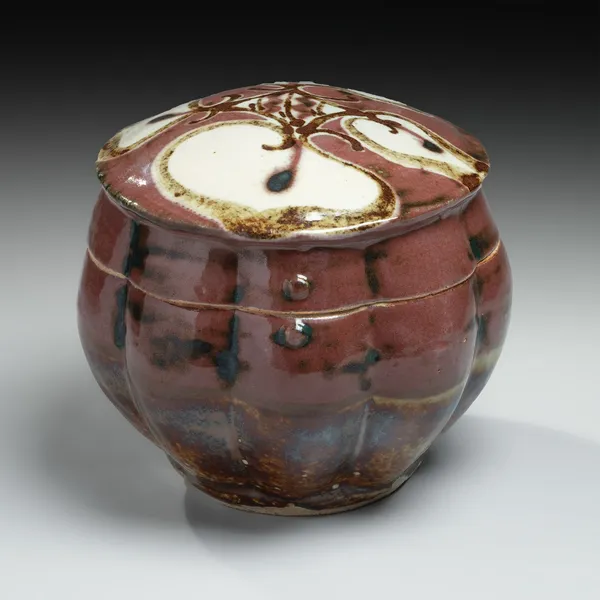
Red copper-glazed, lobed, covered box with floral design, ca. 1950Glazed stoneware
7 1/2 x 8 1/4 in.
Box title: 辰砂食籠 (Shinsha jikirō); Red Copper-Glazed Covered Box
Box signature: 寛 (Kan)
Box seal: 河井寛之印 (Kawai Kan no in); Kawai Kan’s seal -
KAWAI KANJIRŌ
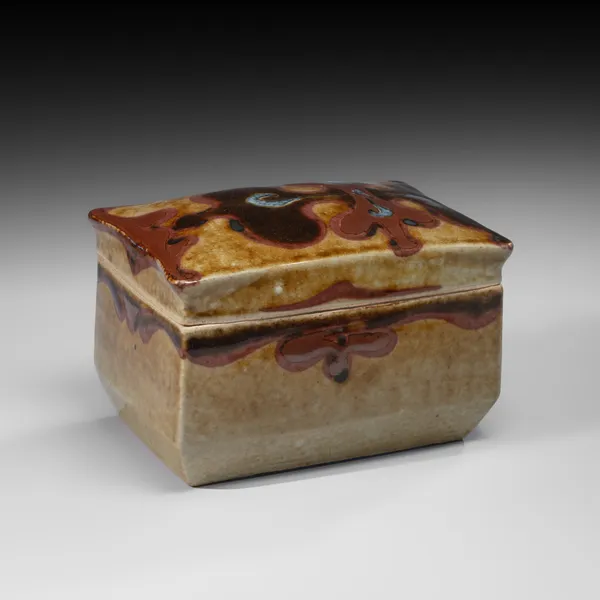
Rectangular box with matching cover decorated with abstract floral design, late 1940sGlazed stoneware
5 5/8 x 8 1/2 x 5 7/8 in.
Box title: 寛二郎作 飴釉塗分喰籠 (Kanjirō saku ameyū nuriwake jikirō); Made by Kanjirō, Yellowish-brown Glazed Box
Box signature: 河井紅苑識 (Kawai Kōha shiki); Authenticated by Kawai Kōha (Kawai Kanjirō’s granddaughter)
Box seal: 河井寛印 (Kawai Kan no in); Kawai Kan’s seal -
KAWAI KANJIRŌ
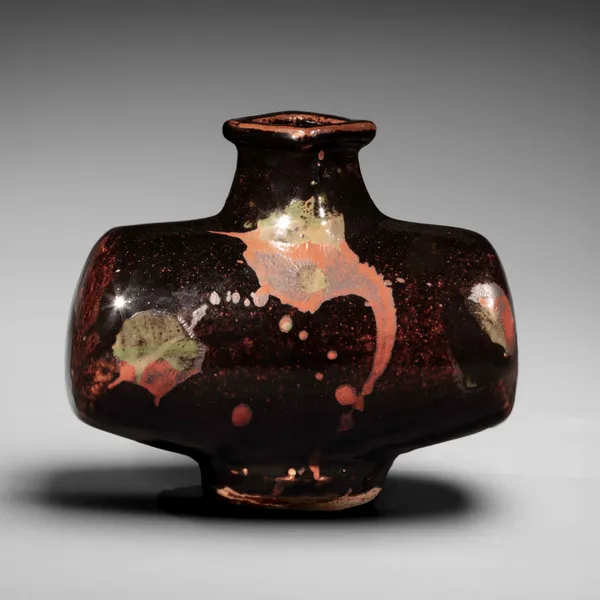
Black barrel-shaped vessel with splashed patterning in red and green, ca. 1960Glazed stoneware
7 1/2 x 8 1/2 x 5 in.
Box title: 黒扁壺 赤青 (Kurohenko sekisei); Black Flattened Vessel with Red and Blue
Box signature: 寛 (Kan)
Box seal: 河井寛之印 (Kawai Kan no in); Kawai Kan's seal -
KAWAI KANJIRŌ
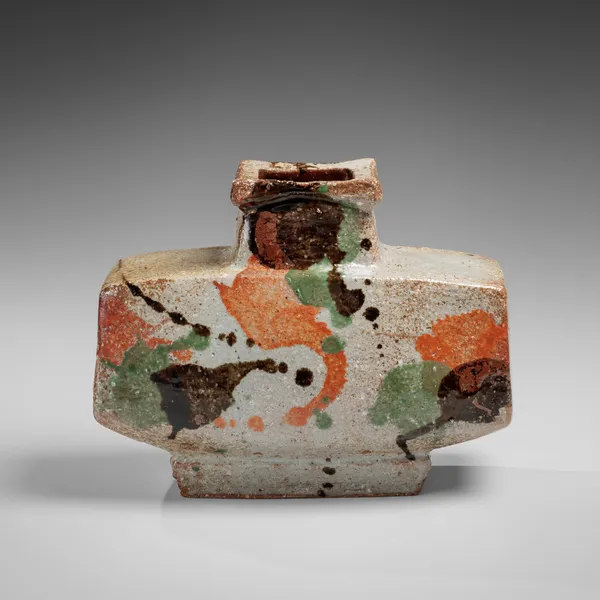
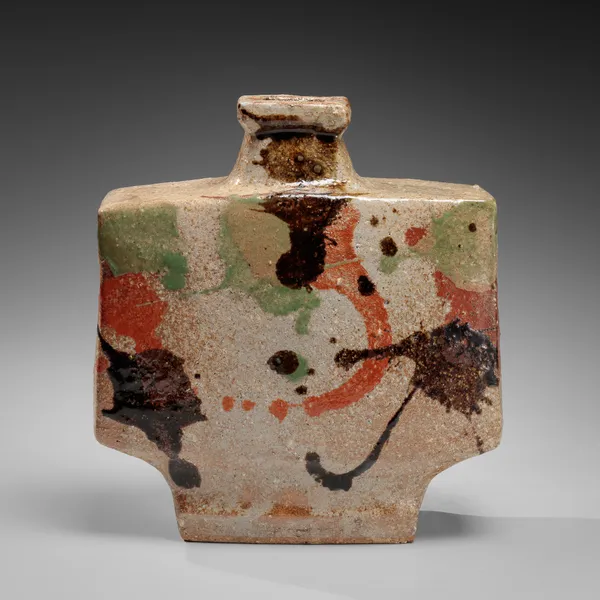
Flattened wide rectangular vessel with raised mouth decorated with sançai glazing, ca. 1960Glazed stoneware
8 1/4 x 10 1/2 x 5 1/4 in.
Box title: 寛次郎作三色扁壷 (Kanjirō saku sanshoku henko); Three-colored Flattened Vessel Created by Kanjirō
Box signature: 河井敏孝識 (Kawai Toshitaka shiki); Authenticated by Kawai Toshitaka, director of the Kawai Kanjirō's House Museum and artist's grandson -
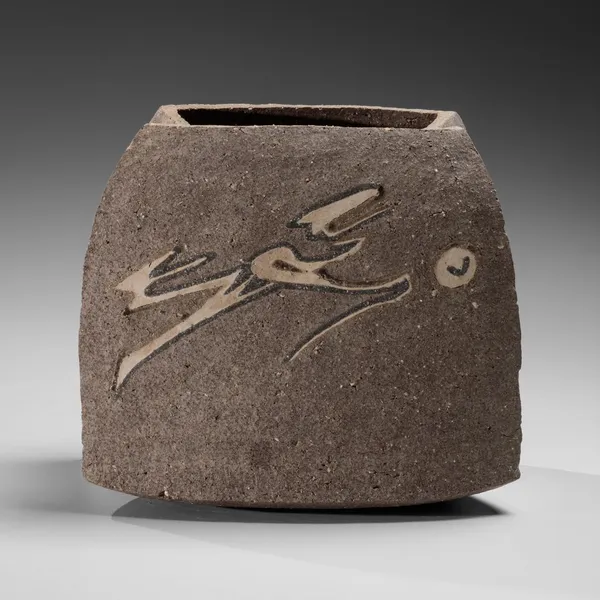
KAWAI KANJIRŌ
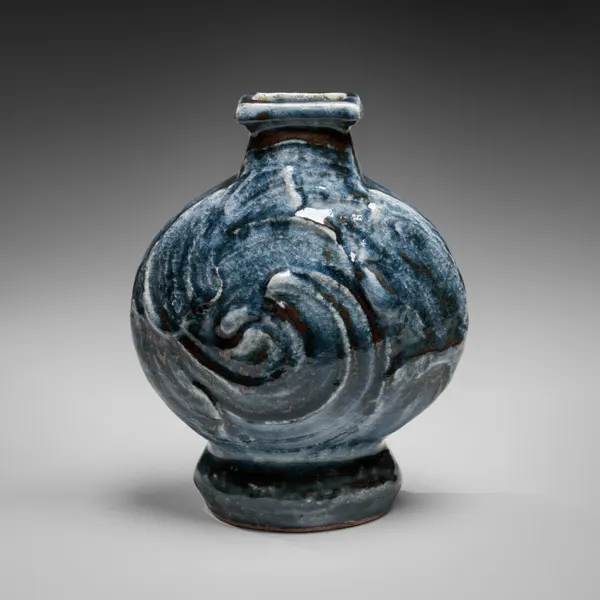
Cobalt-glazed (gosu) flattened circular vessel with raised rectangular mouth and carved decoration, ca. 1950s-60sGlazed stoneware
10 1/8 x 7 7/8 x 5 1/8 in.
Box title: 呉洲扁壺泥刷毛目 (Gosu henko doro hakeme); Cobalt Glazed Flattened Vessel with Brushed Slip
Box signature: 寛 (Kan)
Box seal: 河井寛之印 (Kawai Kan no in); Kawai Kanjirō's seal -
KAWAI KANJIRŌ
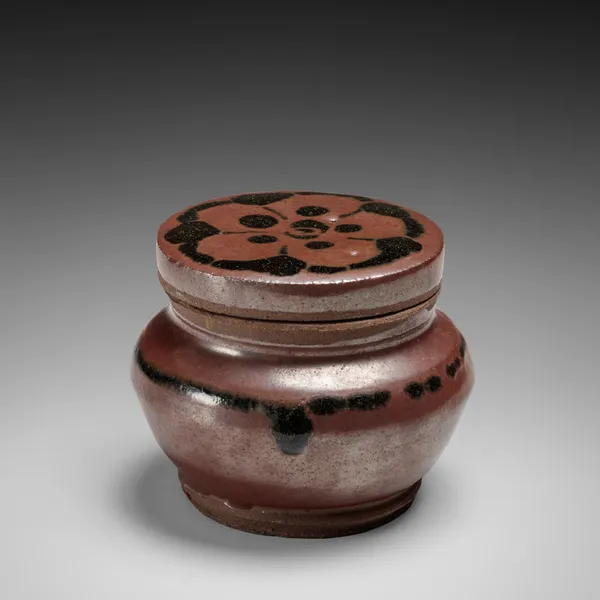
Iron-glazed covered box with stylized floral motif on lid, ca. 1930Glazed stoneware
2 3/4 x 3 3/8 in.
Box title: 鐡藥壺 (Tetsuyaku tsubo); Iron-glazed vessel
Box signature: 寛 (Kan)
Box seal: 河井寛之印 (Kawai Kan no in); Kawai Kan's seal -
KAWAI KANJIRŌ
Flattened round vessel with circular floral motif, 1934Glazed stoneware
9 7/8 x 8 x 7 1/2 in.
Box title: 草花文圗扁壺 (Sōkamonzu henko); Flattened Vessel with Flower and Plant Patterning
Box signature: 寛 (Kan)
Box seal: 河井寛之印 (Kawai Kan no in); Kawai Kan's seal
Note: Also includes handwritten documents by Kawai Toshitaka, director of the Kawai Kanjirō's House Museum and artist's grandson, dated to June 25, 1972 -
KAWAI KANJIRŌ
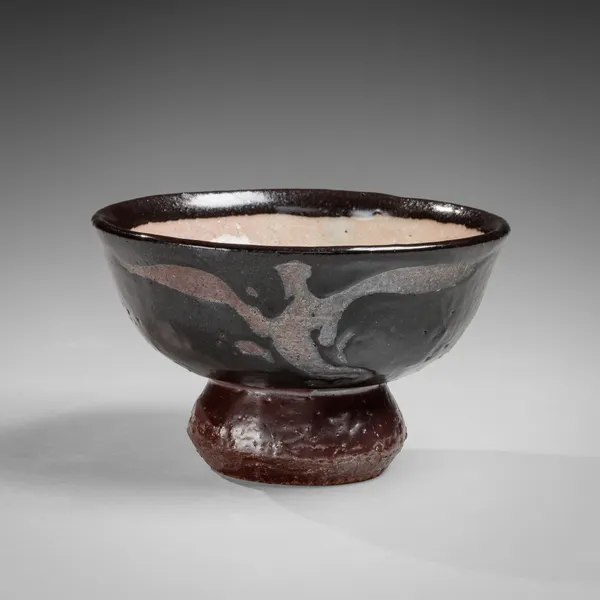
Black teabowl with raised foot and masked phoenix and dragon motifs, ca. 1938Glazed stoneware
3 3/8 x 5 3/4 in.
Box title: 鵬龍文黒釉茶盌 (Hōryū mon kokuyū chawan); Black Teabowl with Phoenix and Dragon Motif
Box signature: 河井寛次郎先生御作 棟方志功記 (Kawai Kanjirō sensei on saku Munakata Shikō shirusu); Work made by Kawai Kanjirō, inscription by Munakata Shikō -
KAWAI KANJIRŌ
Flattened rectangular vessel with raised mouth decorated with sançai glazing, ca. 1960Glazed stoneware
8 1/2 x 7 3/4 x 4 in.
Box title: 三色扁壺 (Sanshoku henko); Three-color Glazed Flattened Vessel
Box signature: 寛 (Kan)
Box seal: 河井寛印 (Kawai Kan no in); Kawai Kan's seal -
KAWAI KANJIRŌ
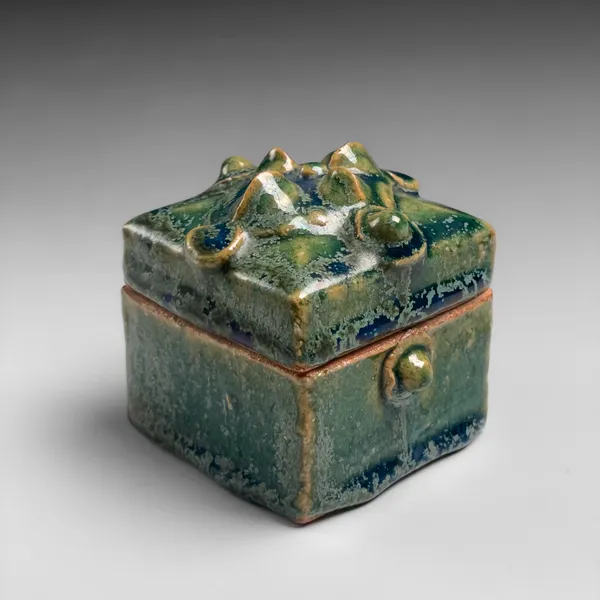
Square lidded container with green glaze and raised flower motif, ca. 1962Glazed stoneware
3 1/8 x 3 3/8 x 2 in.
Box title: 花盒子 (Hana gōsu); Covered Container with Flower Motif
Box signature: 寛 (Kan)
Box seal: 河井寛之印 (Kawai Kan no in); Kawai Kan's seal -
KAWAI KANJIRŌ
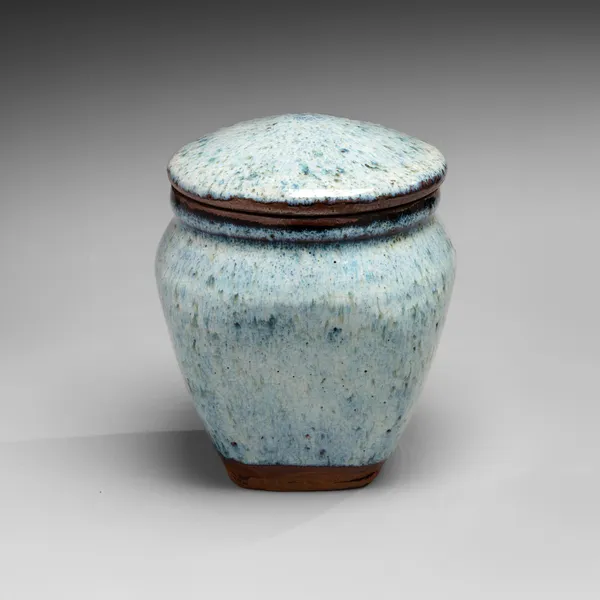
Tapering covered jar with squared-off sides and matching round lid in namako ("sea cucumber") glaze, 1930sGlazed stoneware
5 1/8 x 4 1/2 in.
Box title: 海鼠壷 (Namako tsubo); Sea Cucumber Vessel
Box signature: 寛 (Kan)
Box seal: 河井寛之印 (Kawai Kan no in); Kawai Kan’s seal -
ISHIGURO MUNEMARO
Low, open teabowl with raised foot and yellow brushstroke (hakeme) patterning, ca. 1955Glazed stoneware
2 5/8 x 5 1/2 in.
Box title: 黄刷毛目 盌 (Ki-hakeme wan); Teabowl with Yellow Brushstroke Patterning
Box signature: 栩 (Ku)
Box seal: 栩 (Ku) -
ISHIGURO MUNEMARO
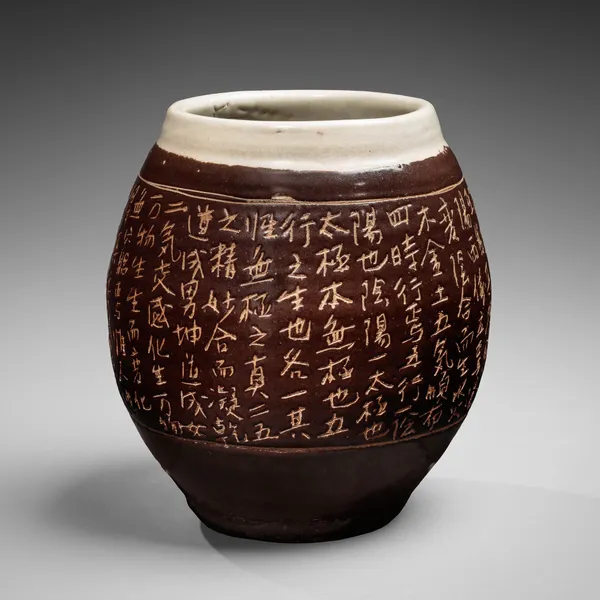
Ovoid vessel incised with Chinese poem, 1936Glazed stoneware
8 1/8 x 7 5/8 in.
Box title: 黒華壷 (Kokka tsubo); Black Glazed Vessel
太極圖説刻文 (Taikyoku-to setsu kokubun); Inscribed with text from Taijitu shuo
八瀬初窯 (Yase shōyō); First firing in the Yase kiln
Box seal: 宗麿造 (Munemaro-zō); Made by Munemaro
Note: Inscribed on this vessel is an excerpt from "Taijitu shuo" 太極圖說 by Northern Song philosopher, Zhou Dunyi 周敦頤. This text explains the origin of the cosmos as emerging from the shifting energies of yin and yang in the form of stillness and movement respectively. From this duality emerges the five elements, which in turn give rise to the ten-thousand beings. -
ISHIGURO MUNEMARO
Large persimmon tenmoku-glazed bowl, ca. 1942-1947Glazed stoneware
2 3/8 x 12 in.
Box title: 柿釉鉢 (Kakiyū bachi); Persimmon Glazed Bowl
Box signature: 栩 (Ku); Munemaro’s pseudonym
Box seal: 栩菴 (Kuan) -
ISHIGURO MUNEMARO
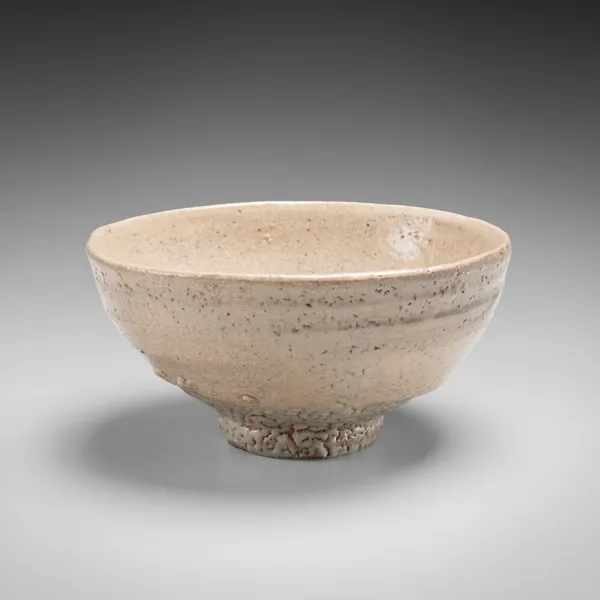
Teabowl with sharkskin texture, titled Abundant Rice Fields (Hyakumangoku), ca. 1957Glazed stoneware
3 3/8 x 6 1/2 in.
Box title: 梅華皮盌 (Kairagi wan); Teabowl with Shark Skin Texture
百萬石 (Hyakumangoku); Abundant Rice Fields
Box signature: 栩 (Ku); Munemaro’s pseudonym
栩庵題 (Kuandai)
Box seal: 栩 (Ku); Munemaro’s pseudonym -
ISHIGURO MUNEMARO
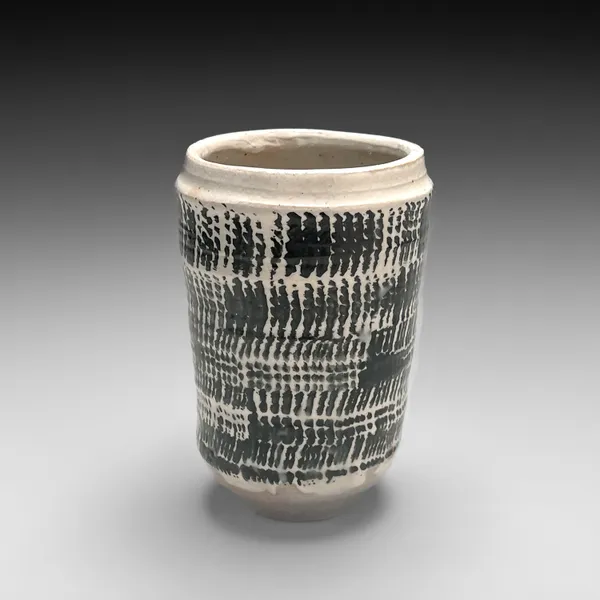
Small cylindrical vessel with black rope-patterning design on white ground, Late 1940s-50sGlazed stoneware
4 7/8 x 3 1/4 in.
Box title: 小壺 (Kotsubo); Small Vessel
Box signature:栩 (Ku) (Munemaro’s pseudonym)
Box seal: 八瀬窯宗麿 (Yase-gama Munemaro) -
ISHIGURO MUNEMARO
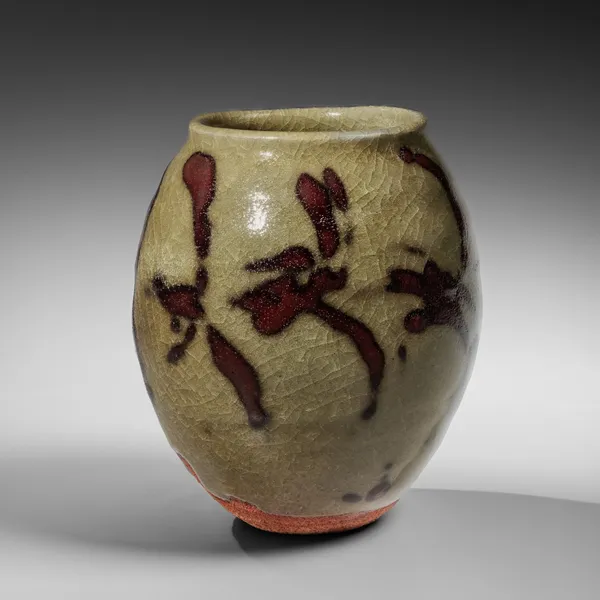
Conical vessel patterned in iron-oxide brushed design over green celadon glaze, ca. 1967Glazed stoneware
6 7/8 x 5 7/8 in.
Box title: ⻘瓷紅彩壷 (Seiji kōsai tsubo); Celadon Red-glazed Vessel
Box signature: 栩翁S (Kuō S) -
ISHIGURO MUNEMARO
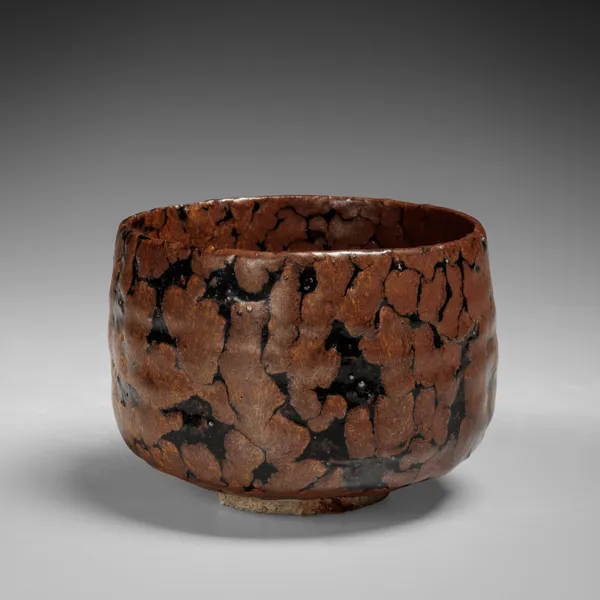
Teabowl with partridge-feather glaze, ca. 1956-1961Glazed stoneware
3 1/2 x 5 x 4 3/8 in.
Box title: 鵲鴣斑盌 (Shakohan wan); Teabowl with Partridge Feather Pattern
Box signature: 栩翁S
Box seal: 栩 (Ku); Munemaro’s pseudonym -
ISHIGURO MUNEMARO
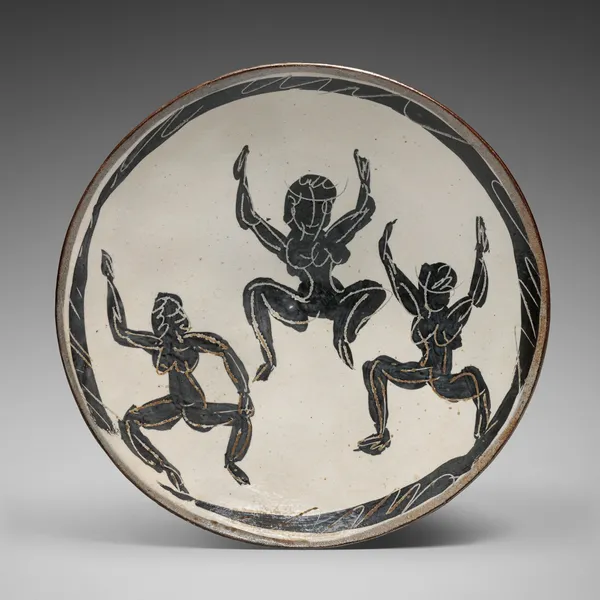
Circular platter with motif of three dancing women, ca. 1948-1950Glazed stoneware
3 x 13 3/4 in.
Plain wooden box
-
ISHIGURO MUNEMARO
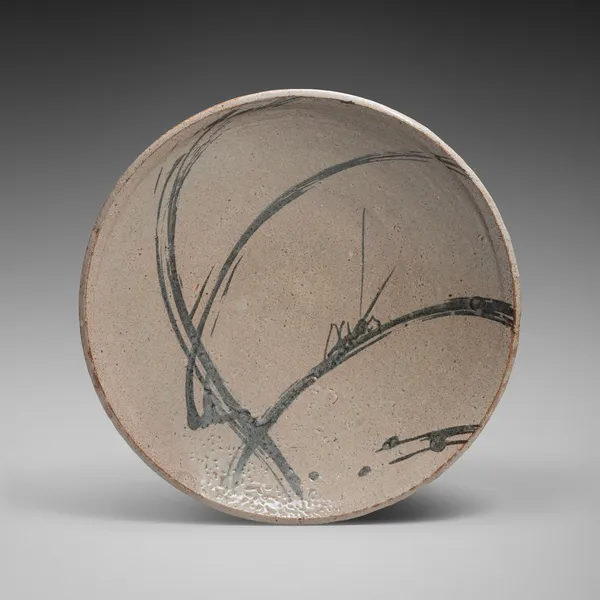
Platter with motif of cricket and grasses in iron underglaze, ca. 1964–1966Glazed stoneware
2 1/2 x 12 in.
Box title: 銕絵草虫文皿 (Tetsue sōchūmon sara); Iron-glazed Platter with Insects and Plants
Box signature: 栩翁S
Box seal: 栩 (Ku); Munemaro’s pseudonym -
OKABE MINEO
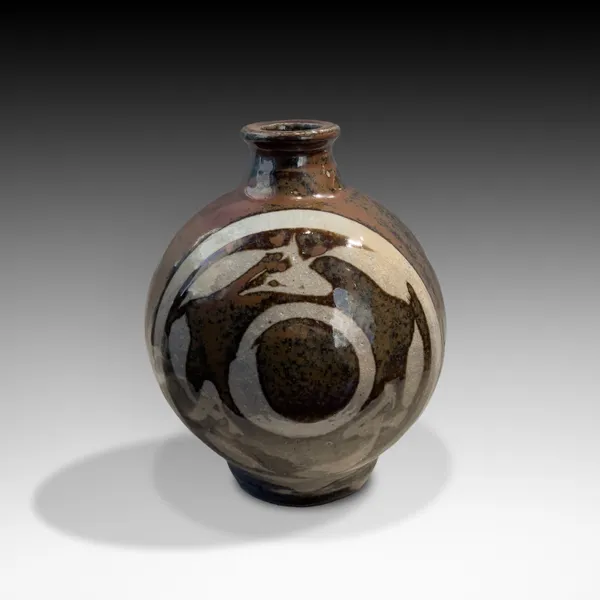
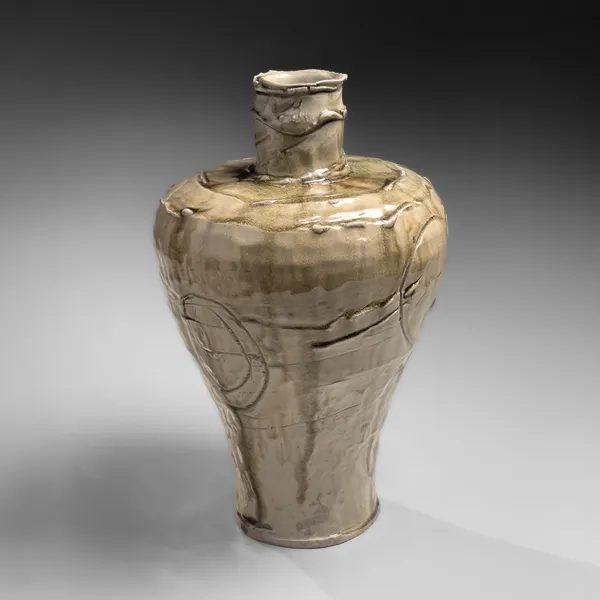
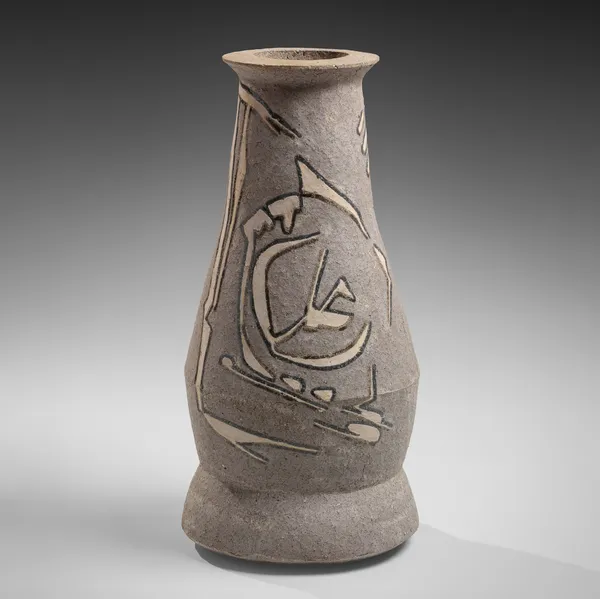
Ko-Seto ash-glazed shouldered vessel with incised abstract curvilinear motifs, 1971Glazed stoneware
16 x 9 3/4 in.
Potter's mark: Artist's mark incised on bottom
Box title: 古瀬戸瓶子 (Koseto heishi); Koseto-style Vessel
Box signature: 嶺男 (Mineo)
Box seal: 嶺男 (Mineo) -
OKABE MINEO
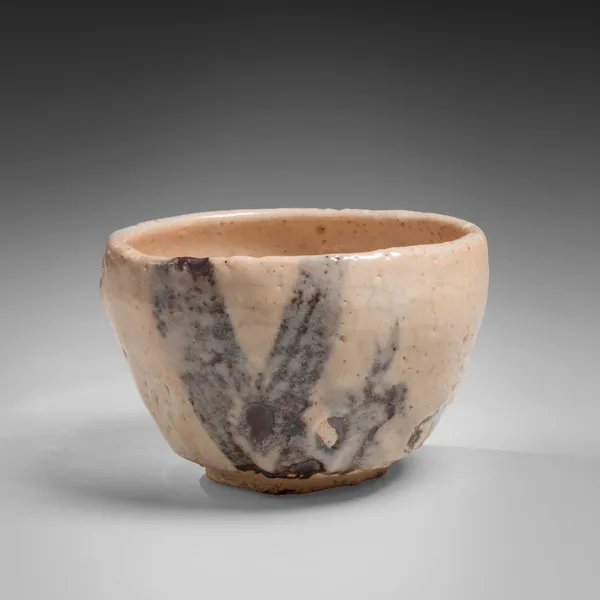
E-Shino-glazed round teabowl with iron-oxide underglaze patterning, 1962Glazed stoneware
3 5/8 x 5 1/2 x 5 1/8 in.
Potter's mark: Artist's mark incised on bottom
Box title: 絵志野茶碗 (E-shino chawan): Painted Shino-glazed Teabowl
Box signature: 嶺男 (Mineo)
Box seal: 嶺 (Mine) -
OKABE MINEO
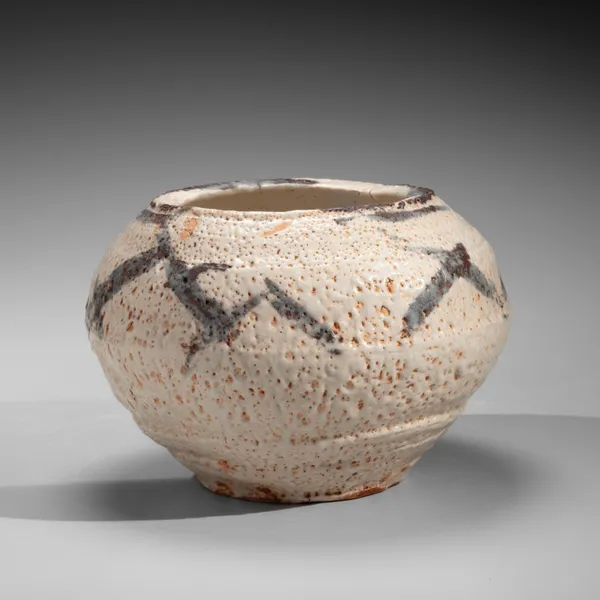
Rounded E-shino vessel with lattice patterning, ca. 1960Glazed stoneware
6 x 9 in.
Box title: 絵志野壺 (E-shino tsubo); Painted Shino-glazed Vessel
Box signature: 嶺 (Mine)
Box seal: 嶺 (Mine)
-
OKABE MINEO
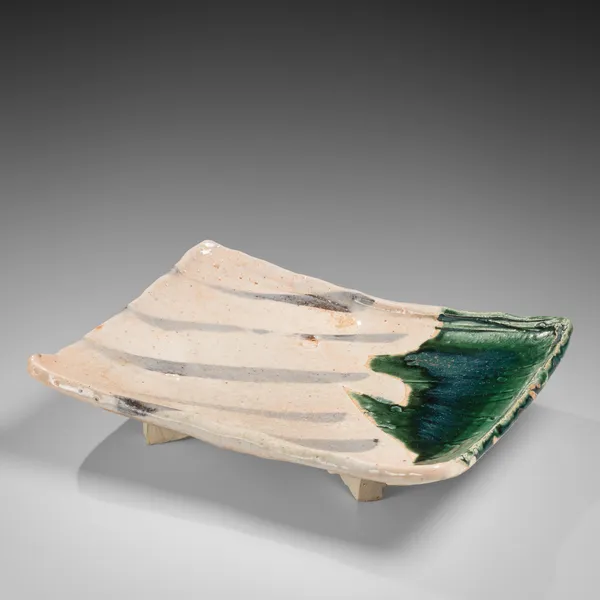
Shino and Oribe-glazed rectangular platter with four feet, 1965Glazed Stoneware
2 5/8 x 11 3/4 x 9 3/4 in.
Box title: 志野織部角皿 (Shino Oribe kakuara); Square Platter with Shino and Oribe Glaze
Box signature: 嶺男 (Mineo)
Box seal: 嶺 (Mine) -
OKABE MINEO
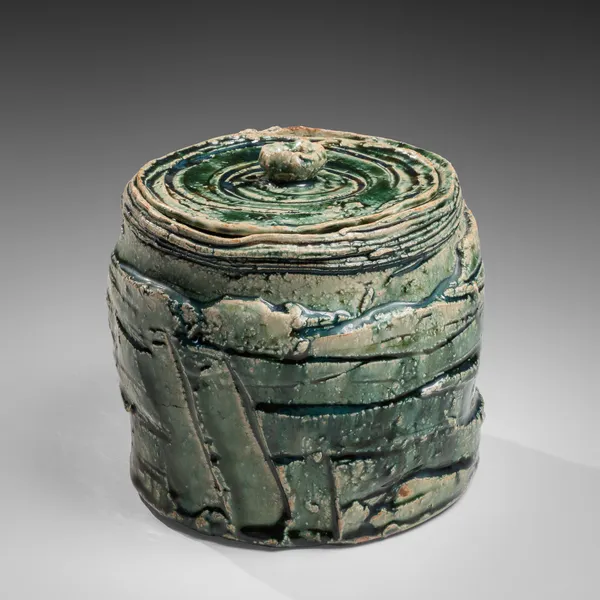
Oribe-glazed round waterjar with carved banding and matching circular cover, ca. 1964Glazed stoneware
6 x 6 1/4 x 6 in.
Potter's mark: Artist's mark incised on bottom
Box title: 青織部水指 (Ao Oribe mizusashi); Blue Oribe Glazed Waterjar
Box signature: 嶺男 (Mineo)
Box seal: 嶺 (Mine) -
OKABE MINEO
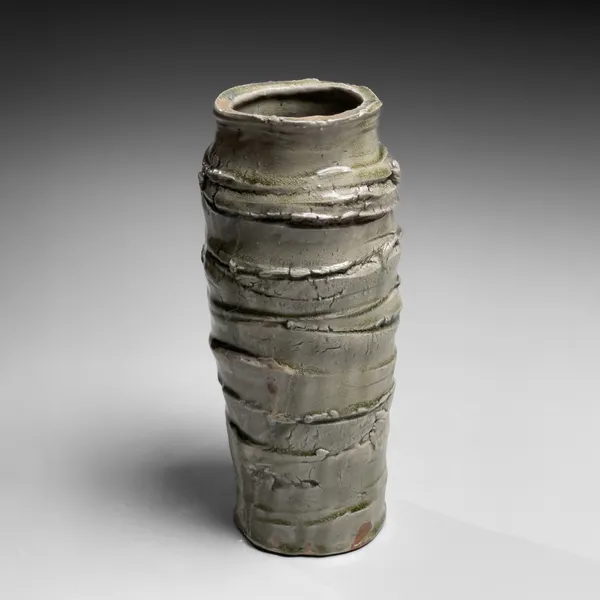
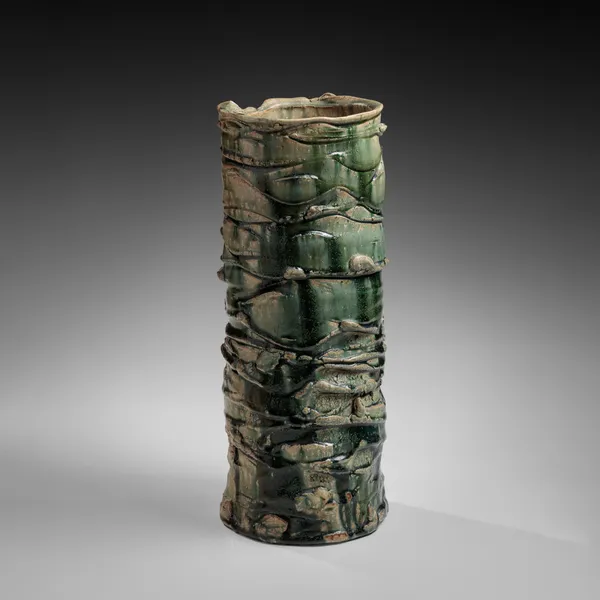
Ash-glazed columnar vessel with irregular carved banding, 1963Glazed stoneware
10 3/8 x 4 1/2 in.
Potter's mark: Artist's mark incised on bottom
Box title: 灰釉切立花生 (Haiyū kiritate hanaire); Ash-glazed Vertical Flower Vessel
Box signature: 嶺男 (Mineo)
Box seal: 嶺 (Mine) -
OKABE MINEO
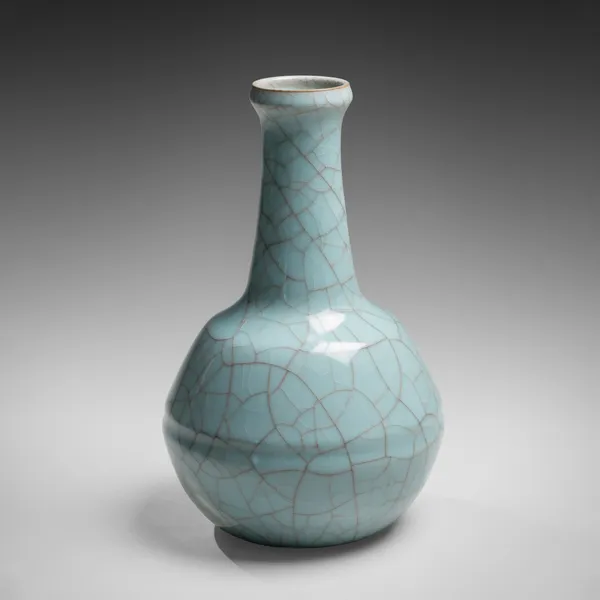
Funseiji fulling block (kinuta)-shaped vessel with pale blue craquelure celadon glaze, ca. 1969Glazed stoneware
9 7/8 x 6 1/8 in.
Box title: 粉青瓷砧 (Funseiji kinuta); Celadon Glazed Kinuta-shaped Vessel
Box signature: 嶺男 (Mineo)
Box seal: 嶺男 (Mineo) -
OKABE MINEO
Tall Oribe-glazed columnar vessel with irregular carved bands, 1967Glazed stoneware with original kintsugi repair by artist
18 1/2 x 7 1/4 in.
Potter's mark: Artist's mark incised on bottom
Box title: 織部大筒 (Oribe ōzutsu); Oribe Large Cylinder
Box signature: 嶺男 (Mineo)
Box seal: 嶺男 (Mineo) -
OKABE MINEO
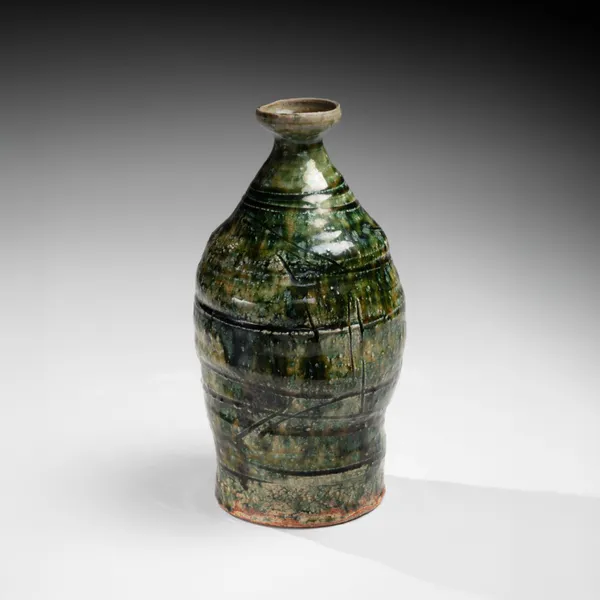
Oribe-glazed vase with narrow neck, flaring mouth, and carved banding, 1955Glazed stoneware
8 3/8 x 4 1/2 x 4 3/8 in.
Potter's mark: Artist's mark incised on bottom
Box title: 織部一輪挿 (Oribe ichirinzashi); Oribe Glazed Single-stem Vase
Box signature: 嶺 (Mine)
Box seal: 嶺 (Mine) -
KAMODA SHŌJI
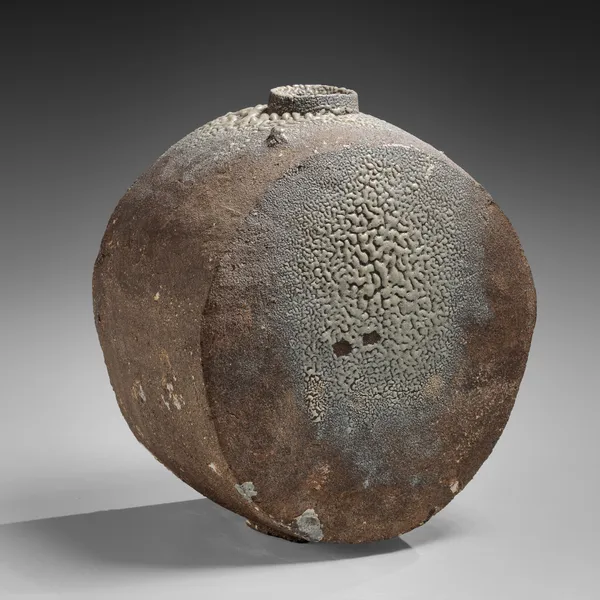
Ash-glazed round vase with upraised mouth, 1968Glazed stoneware
10 1/4 x 8 3/4 x 6 5/8 in.
Box title: 炻器扁壷 (Sekki henko); Stoneware Flattened Vessel
Box signature: 加守田章二 (Kamoda Shōji)
Box seal: 章 (Shō) -
KAMODA SHŌJI
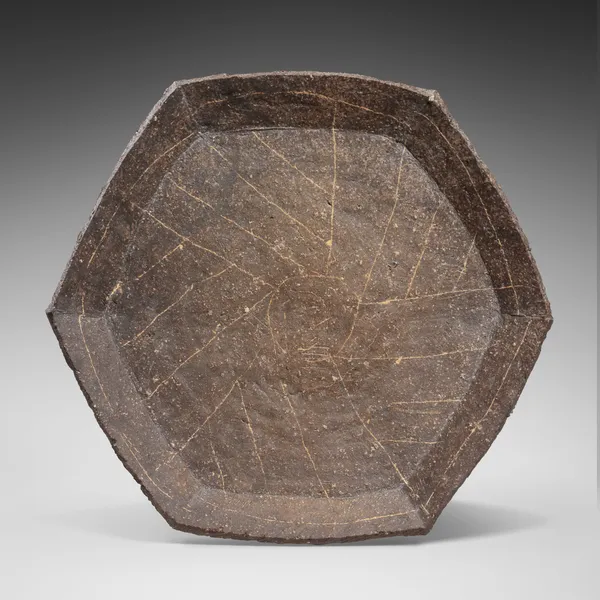
Hexagonal platter with inlaid linear patterning, 1968Stoneware
1 3/8 x 16 in.
Potter's mark: 章 (Shō) incised on bottom
Box title: 加守田章二作 皿 (Kamoda Shōji saku sara); Platter created by Kamoda Shōji)
Box signature: 加守田昌子識 (Kamoda Masako shiki); Authenticated by Kamoda Masako (Kamoda Shōji's wife)
Box seal: 昌 (Masa) -
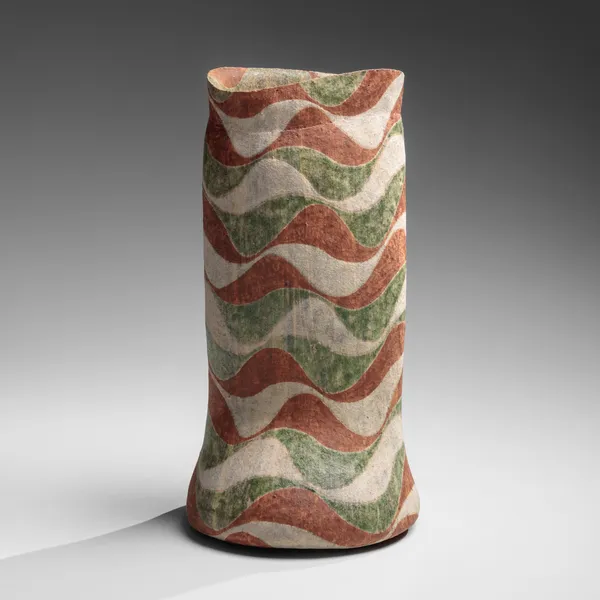
KAMODA SHŌJI
Vessel with undulating red and green wave-like linear banding, 1971Glazed stoneware
11 7/8 x 6 1/8 x 6 in.
Potter’s mark: Artist’s mark incised on bottom
Paper label on bottom: “21” (exhibition number)
Box title: 筒形彩陶 (Tsutsugata saitō); Painted Cylindrical Form
Box signature: 加守田章二 (Kamoda Shōji)
Box seal: 章 (Shō) -
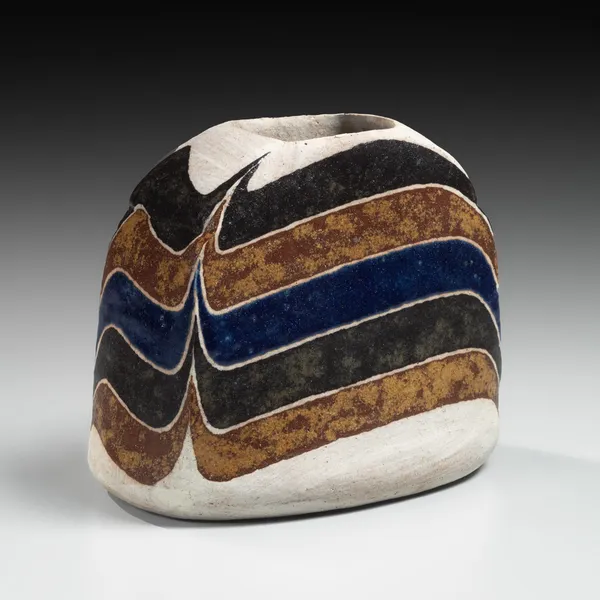
KAMODA SHŌJI
Standing flattened, rounded rectangular vessel decorated with colored, curvaceous bands in light brown, ochre yellow, cream and blue overglaze enamel, 1975Glazed stoneware
7 3/4 x 8 1/2 x 5 1/2 in.
Potter’s mark: 一九七五 壷 (Senkyūhyakunanajūgo tsubo); 1975 Vase (incised on bottom)
Box title: 一九七五 壷 (Senkyūhyakunanajūgo tsubo); 1975 Vase
Box signature: 加守田章二 (Kamoda Shōji)
Box seal: 章 (Shō) -
KAMODA SHŌJI
Vessel, 1974Glazed stoneware
8 x 8 7/8 x 5 1/8 in.
Potter's mark: 一九七四 章 (Senkyūhyakunanajūyon Shō); 1974 Shō (incised on base)
Box title: 一九七四 壷 (Senkyūhyakunanajūyon tsubo); 1974 Vessel
Box signature: 加守田章二 (Kamoda Shōji)
Box seal: 章 (Shō) -
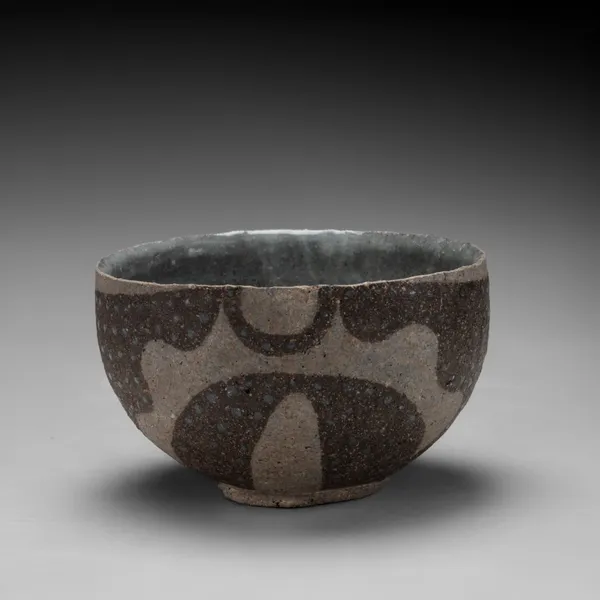
KAMODA SHŌJI
Large round teabowl with abstract undulating patterning, ca. 1973Glazed stoneware
3 x 5 x 4 7/8 in.
Potter's mark: 章 (Shō) incised on bottom
Box title: 茶碗 (chawan); Teabowl
Box signature: 加守田章二 (Kamoda Shōji)
Box seal: 章 (Shō) -
KAMODA SHŌJI
Flattened rectangular vessel decorated with colored, enamel-glazed radiating linear patterns, 1978Glazed stoneware
11 3/4 x 7 7/8 x 4 1/2 in.
Potter’s mark: 一九七八 壷 (Senkyūhyakunanajūhachi tsubo); 1978 Vase (incised on bottom)
Box title: 一九七八 壷 (Senkyūhyakunanajūhachi tsubo); 1978 Vase
Box signature: 加守田章二 (Kamoda Shōji)
Box seal: 章二 (Shōji) -
KAMODA SHŌJI
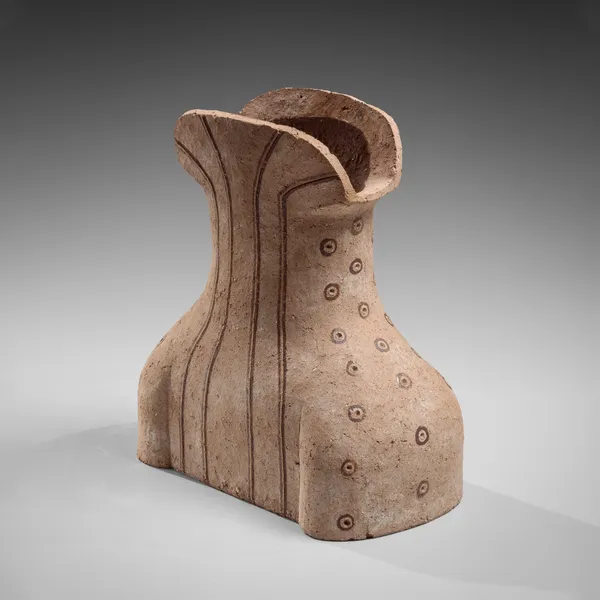
Cinched torso-like vessel with incised linear and dot motifs accentuated with slip and glaze, 1974Glazed stoneware
9 1/8 x 8 1/2 x 4 1/2 in.
Potter's mark: 一九七四 章 (Senkyūhyakunanajūyon Shō); 1974 Shō (incised on bottom)
Box title: 一九七四 壷 (Senkyūhyakunanajūyon tsubo); 1974 Vessel
Box signature: 加守田章二 (Kamoda Shōji)
Box seal: 章 (Shō) -
KAMODA SHŌJI
Tall elongated vase with curvilinear calligraphic patterning in white clay inlays, 1974Glazed stoneware
15 1/2 x 7 3/8 x 6 in.
Potter's mark: 一九七四 章 (Senkyūhyakunanajūyon Shō); 1974 Shō (incised on bottom)
Box title: 一九七四 壷 (Senkyūhyakunanajūyon tsubo); 1974 Vessel
Box signature: 加守田章二 (Kamoda Shōji)
Box seal: 章 (Shō) -
KAMODA SHŌJI
Bulbous gray vessel with tall neck and flared rim, 1979Slip-glazed stoneware with overglaze enamels
13 x 9 1/8 x 7 3/4 in.
Potter's mark: 一九七九 章 (Senkyūhyakunanajūkyū Shō); 1979 Shō (incised on bottom)
Box title: 一九七九 壷 (Senkyūhyakunanajūkyū tsubo); 1979 Vessel
Box signature: 加守田章二 (Kamoda Shōji)
Box seal: 章 (Shō) -
KAMODA SHŌJI
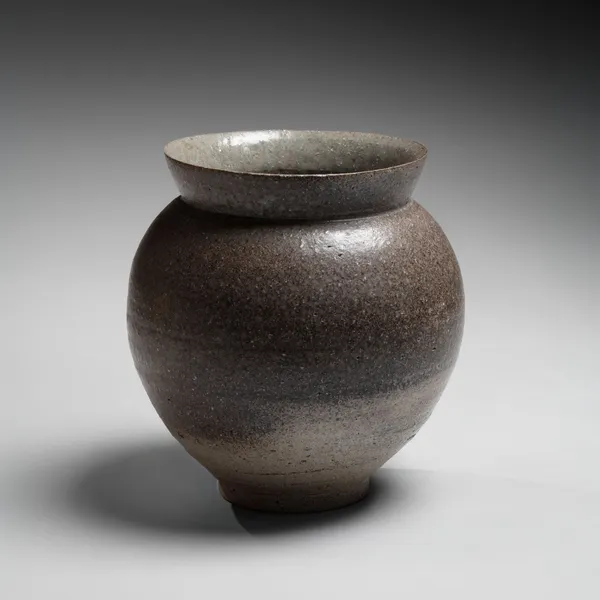
Wide mouth vessel, ca. 1964Ash-glazed stoneware
7 1/2 x 7 1/8 in.
Paper label on bottom: 章 (Shō) sealed on paper
Box title: 灰釉壷 (Haiyū tsubo); Ash-glazed Vessel
Box signature: 加守田章二 (Kamoda Shōji)
Box seal: 章 (Shō) -
TANAKA SAJIRŌ
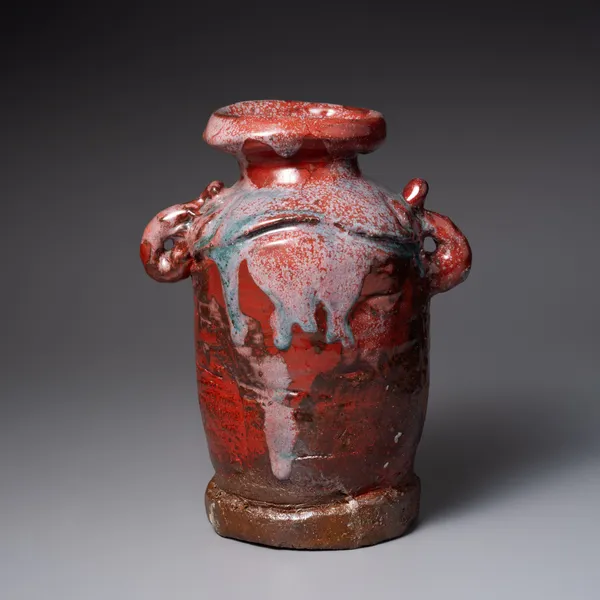
Shinsha (copper red) glazed handled vase with raised, flared mouth, 2025Glazed stoneware
10 1/4 x 7 7/8 x 6 in.
Box title: 辰砂花入 (Shinsha hanaire); Red Copper-glazed Vase
Box signature: 佐次郎 (Sajirō)
Box seal: 法月 (Hōgetsu) -
TANAKA SAJIRŌ
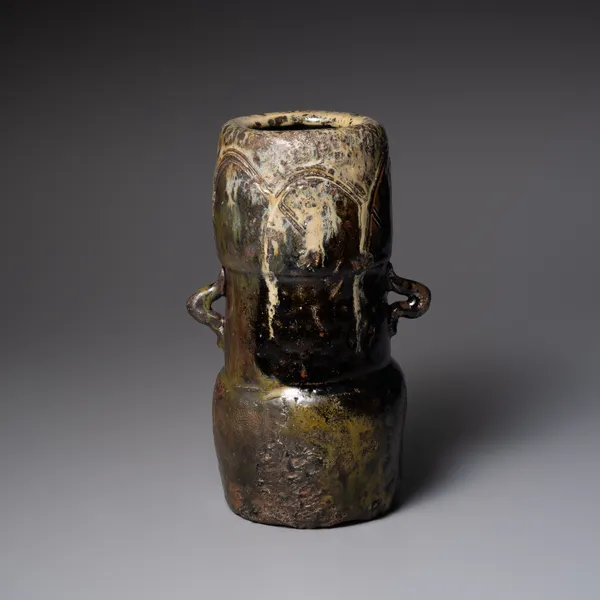
Korean Karatsu vase with paired lugs and tall columnar neck, 1985Glazed stoneware
9 3/4 x 5 3/4 x 4 3/4 in.
Box title: 朝鮮唐津花入 (Chōsen Karatsu hanaire); Korean Style Karatsu Vase
Box signature: 佐次郎 (Sajirō)
Box seal: 佐次郎 (Sajirō) -
TANAKA SAJIRŌ
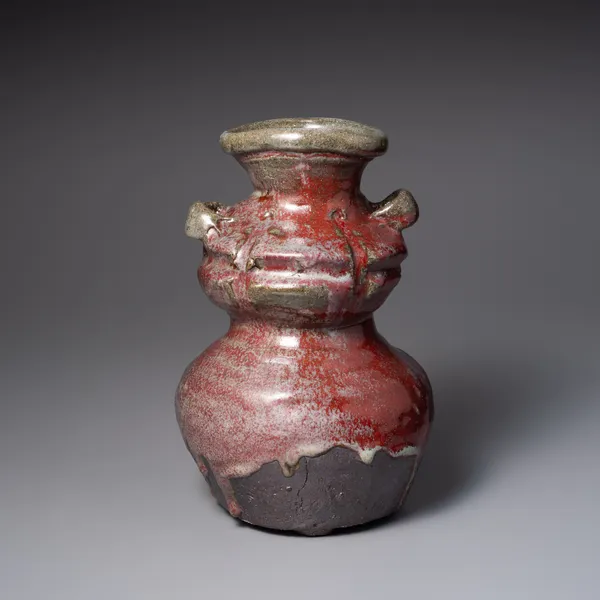
Shinsha (copper red) gourd-shaped vase with handles and flaring mouth, 2025Glazed stoneware
9 1/8 x 6 1/8 x 6 in.
Box title: 辰砂瓢花入 (Shinsha hyō hanaire); Red Copper-glazed Gourd Shaped Vase
Box signature: 佐次郎 (Sajirō)
Box seal: 法月 (Hōgetsu) -
TANAKA SAJIRŌ
Low-sided slightly faceted teabowl, titled, Crimson Sunset (Akane iriai), 2025Glazed stoneware
3 3/4 x 6 1/4 x 6 in.
Potter's mark: Artist's mark incised on foot
Box title: 茜入相茶碗 (Akane iriai chawan); Crimson Sunset Teabowl
Box signature: 佐次郎 (Sajirō)
Box seal:法月 (Hōgetsu) -
TANAKA SAJIRŌ
Karatsu waterjar with two lugs and recessed, knobbed lid, titled, As Clouds Form, 2025Glazed stoneware
8 3/8 x 9 x 8 in.
Box title:
唐津水指 (Karatsu mizusashi); Karatsu Waterjar
銘 雲起る時 (Mei: Kumo okiru toki); Titled, As Clouds Form (The term 雲起時 is a reference to the line 行到水窮処、坐看雲起時, which is often used in Zen calligraphy)
Box signature:
令和七年極月 (Reiwa nana nen gokugetsu); December 2025
法月 佐次郎 (Hōgetsu Sajirō)
Box seal:法月 (Hōgetsu) -
TANAKA SAJIRŌ
Faceted creamy white teabowl with dripping burgundy glaze, titled, Vermillion Cloud (Shu’un), 2025Glazed stoneware
4 3/8 x 5 1/4 x 5 1/8 in.
Box title: 朱雲茶碗 (Shu'un chawan); Vermillion Cloud Teabowl
Box signature: 佐次郎 (Sajirō)
Box seal: 法月 (Hōgetsu)
-
-
Catalogue Introduction
For Asia Week New York, Joan B Mirviss LTD presents Six Celestials, an exhibition featuring selected masterpieces by six artists whose seminal careers established the foundations upon which contemporary Japanese ceramics has been built. Each of these artists combined their unrivaled technical expertise in historical ceramic traditions with a unique and compelling artistic vision. By placing their diverse bodies of work in conversation with one another, the exhibition highlights the ways in which each of these twentieth-century icons helped pave the way for the emergence of Japanese ceramics as it exists today—one of the most dynamic and exciting fields of contemporary art.
It is impossible to overstate the impact of Tomimoto Kenkichi's (1886-1963) legacy on contemporary Japanese ceramics. During his lifetime, he embodied a radically new vision of the ceramist as an artist rather than an artisan or craftsperson. Unlike the majority of his generation's ceramists, he was not born to a family of potters, nor did he ever formally apprentice in the trade. Instead, he received a thoroughly Western education, studying abroad in London before graduating from Tokyo Art School (now Tokyo University of the Arts), where he studied architecture and design. Throughout his career, he proudly proclaimed himself an "amateur" ceramist, an identity that was critical in the freedom it provided. Tomimoto fervently pursued originality in his work and avoided copying the work of past masters at all costs. He spent time sketching in nature to develop the meticulous polychrome enamel overglaze patterns for which he was designated a Living National Treasure. As the founder of the ceramics department at Kyoto City University of Arts, Tomimoto was also at the center of the university's emergence as the training ground for the next generation of cutting-edge Japanese ceramic artists. As a teacher, he taught his students to pay attention to the relationship between form and decoration and instilled in them the critical value of originality. Indeed, many of his students went on to become leaders of the field who successfully cemented the status of Japanese clay in the world of contemporary art.
The son of a wealthy family, Ishiguro Munemaro's (1893-1968) decision to pursue ceramics was inspired by an early encounter with one of only three extant Song-dynasty yōhen tenmoku teabowls designated as national treasures (Inaba tenmoku). Captivated by the radiance of this lost glazing technique, Ishiguro dedicated his life to the pursuit of historical Chinese glazes. Having never formally apprenticed under any specific teacher, Ishiguro taught himself ceramics primarily by creating copies of historical wares. Over the course of his experiments, he perfected a wide range of historical styles, including Raku, Tang sançai (three-color), Mishima, and Karatsu. He was particularly lauded for recreating the highly difficult persimmon tenmoku glaze as well as the konoha (leaf print) tenmoku technique. His mastery of historical glazes earned him the designation of Living National Treasure in 1955. Despite their solid roots in the foundation of East Asian ceramic tradition, Ishiguro's ceramics even today retain a remarkable air of originality. Ishiguro used his repository of historical techniques in never-before-seen combinations while introducing fresh and contemporary motifs that express his unique vision as an artist.
In contrast with these two contemporaries, Kawai Kanjirō (1890-1966) intentionally eschewed formal honors-including the title of Living National Treasure-for his masterful work, remaining true to the spirit of the Mingei (folk art) movement that he helped pioneer. He began his career in ceramics in 1910, when he enrolled in the ceramics division of a university in Tokyo. Upon graduation, he took a job at an important research center in Kyoto that specialized in historical East Asian ceramic techniques. There, he was said to have mixed the formulas for more than ten-thousand glazes. While this is likely an exaggeration, Kawai used his time there to develop his remarkable mastery of historical glazes from China, Korea, and Japan that later served as the foundation of his success as a ceramic artist. Through careful control of the glaze formula and firing conditions, he was able to achieve a wide range of unique and highly coveted effects. A notably prolific artist, Kawai used these to create distinctive designs and motifs on mold-cast ceramic forms, which he then fired in the climbing kiln he had built in the heart of Kyoto's Gojōzaka Kiyomizu ceramic district. Over the course of his career, Kawai transcended the very category of Mingei that he had helped define as his works developed from their roots in historical techniques to incorporate thoroughly modern elements of abstract expression.
Okabe Mineo (1919-1990) was born to a family of ceramists in the historic ceramic center of Seto. As a child, he was mentored in the world of clay by his grandfather, Kanō Kuwajirō, who would take him to clay pits and historic kiln sites. Okabe's father, Katō Tōkurō, was a renowned scholar of Momoyama-period ceramics and a ceramist in his own right, but the two were never close. Indeed, Okabe elected to change his surname from Katō to Okabe, his wife's maiden name, in 1978. By the time he started training at the Aichi Prefecture Seto Ceramics School, Okabe's skills already surpassed those of many of his instructors. It was not until 1947, however, that he began his ceramic career in earnest. Though he struggled with fragile health and family challenges until his death in 1990, Okabe created a diverse oeuvre of natural glazes and ceramic forms over the course of his career. At the core of his work is the relationship between clay forms and the classical glazes that adorn them. The creviced and textured surfaces of vessel bodies that he carved, incised, and impressed with a variety of tools draw attention to the seductive way in which the colors of his Oribe and ash glazes shift as pool and drip over the vessel forms. In contrast, Okabe tended to apply his Shino and celadon glazes over simpler clay forms, allowing the texture of the glaze itself-from the softly dimpled surface of Shino glaze to the deep craquelure that runs through his celadon-to take center stage. The exception to this rule-his celebrated celadon Jōmon series-proved to be the acme of his career. Okabe's brilliant work earned numerous awards and remains highly coveted even today.
As a youth during World War II, Kamoda Shōji (1933-1983) discovered a passion for painting when it was not safe to play outside. His talent was quickly recognized, earning him awards at local exhibitions. When it came time to start university, however, he chose to pursue ceramics, a medium in which he had no experience, at the Kyoto City University of Arts ceramics department that had just been founded by Tomimoto Kenkichi two years prior. The time that he spent under Tomimoto's tutelage was transformative. Like his mentor, Kamoda had no family roots in the world of Japanese ceramics, allowing him the freedom to pursue his own exploration of the medium's potential. After graduating, he worked for a mass-market ceramic production company for two years before moving to northeastern Japan, where he came into his own as an independent artist. Embracing Tomimoto's call for originality, Kamoda's oeuvre is characterized by constant experimentation and transformation. At each of the two to three solo shows he held each year, he debuted unique bodies of work that employed new forms, glazes, techniques, and motifs that were highly sophisticated and fully realized as works of fine art. Each of these bodies of work contained the seeds of what was to come next, and Kamoda's complete oeuvre can be understood as a unified logical progression. This astonishing feat earned him a devoted audience of passionate collectors. Though his life was cut tragically short by leukemia at the age of 49, the legacy of Kamoda's twenty-year ceramic career continues to shape the current trajectory of contemporary Japanese clay art.
The only artist in this exhibition still living, Tanaka Sajirō (b. 1937) is even today energetically creating ceramics at nearly the age of 90. A native of Kyūshū, he was long drawn to the region's historical Karatsu ceramic tradition that is rooted in the aesthetics and techniques developed by potters in Joseon Korea. He has also been involved in archeological excavations of Jōmon and Yayoi kiln sites. As a ceramist, Tanaka specializes in the so-called Korean Karatsu (chōsen Karatsu) style, which is characterized by the striking pairing of two or more high-contrast glazes that drip sensuously over one another when fired in the kiln, creating a vivid spectrum of colors where they merge. He infuses his ceramics with a sense of poetry and spirituality gained from long years of cultivation as an ordained Zen Buddhist priest.
In many ways, the six celestials featured in this exhibition were pioneers under whose stewardship Japanese ceramic art was carried through the twentieth century. Born at the close of the nineteenth century, Tomimoto, Ishiguro, and Kawai all played critical roles ushering Japanese clay into this new period during a time of great turbulence and transformation in Japanese history. As the apogees of the following generation, Okabe, Kamoda, and Tanaka built their ceramic legacies in the second half of the century, shaping the trajectory of Japanese clay in the post-war world. While their careers took radically divergent paths, all six of these artists embody the ideal unity of technical prowess and independent artistic perspective that has allowed Japanese ceramics to emerge forcefully into the realm of first-rate contemporary art.
—Nicolle Bertozzi